Investment Casting Process Explained: A Comprehensive Guide to Precision Manufacturing
Manufacturing precision aerospace components demands exceptional accuracy and repeatability. The investment casting process explained in this comprehensive guide reveals why this ancient technique remains the cornerstone of modern aerospace, defense, and medical device manufacturing. Understanding how investment casting works enables engineers and procurement professionals to make informed decisions about component production methods that deliver superior quality and cost-effectiveness.
The investment casting process explained by industry experts at Unitritech demonstrates how this sophisticated manufacturing method produces complex geometries with tolerances as tight as ±0.005 inches. As India’s first Airbus-approved investment casting foundry, our experience with thousands of aerospace components provides unique insights into this remarkable investment casting method. Whether you’re designing aircraft engine parts, medical implants, or defense systems, understanding the lost wax casting steps helps optimize your component design for manufacturability and performance.
What is Investment Casting? Understanding the Fundamentals
The investment casting process explained begins with a fundamental definition: investment casting is a precision manufacturing technique that creates metal parts by pouring molten metal into a ceramic mold created around a wax pattern. This investment casting method derives its name from the ceramic “investment” or shell that encases the pattern, not from financial investment.
How investment casting works has remained conceptually similar for over 5,000 years, yet modern technology has refined the process to produce aerospace-grade components with unprecedented precision. The term “lost wax casting” describes what happens during production—the wax pattern is literally lost or melted away to create the cavity for metal pouring.
The investment casting process explained to manufacturing engineers typically emphasizes three critical advantages. First, precision and complexity: the investment casting method produces parts with intricate internal passages, thin walls, and complex external geometries that would be impossible or prohibitively expensive to machine from solid stock. Second, material versatility: this casting process works with virtually any metal alloy, from aluminum and stainless steel to exotic superalloys like Inconel 718 and titanium alloys used in aerospace applications. Third, cost-effectiveness: despite sophisticated tooling requirements, investment casting reduces overall manufacturing costs by minimizing machining operations, reducing material waste, and enabling near-net-shape production.
The Investment Casting Process Explained: Step-by-Step Breakdown
Understanding how investment casting works requires examining each stage of production. The investment casting process explained here represents industry best practices refined through decades of aerospace manufacturing experience.
Pattern Creation and Tooling Development
The lost wax casting steps begin with creating an exact wax replica of the final part. Engineers develop injection molds or dies that will produce wax patterns, accounting for both wax shrinkage and subsequent metal shrinkage during solidification. Heated wax, typically maintained at 150-170°F, is injected into the metal die under pressure. The wax cools and solidifies into a precise pattern matching the final component geometry.
Each wax pattern undergoes dimensional inspection to ensure conformance to specifications before proceeding to the next stage. Modern facilities like Unitritech utilize CAD/CAM software to optimize tool design, ensuring the investment casting method produces consistent, high-quality patterns that translate into superior final castings.
Assembly and Tree Building
The lost wax casting steps continue with assembling individual wax patterns into a tree-like structure. Engineers attach wax patterns to a central wax sprue, which serves as the trunk, using gates that act as branches. This assembly allows multiple parts to be cast simultaneously while ensuring proper metal flow throughout the system.
The gating system includes runners that create channels for metal flow and risers that serve as reservoirs feeding shrinkage during solidification. Proper design is critical to how investment casting works successfully. Depending on part size and complexity, trees may hold from a few large components to hundreds of small parts, with the investment casting method optimizing tree design for maximum efficiency and casting quality.
Shell Building – The Investment Process
This crucial stage of the investment casting process explained creates the ceramic mold that will withstand molten metal temperatures exceeding 2,800°F. The wax tree is dipped into a fine ceramic slurry, typically colloidal silica with zircon or alumina flour. This primary coat captures the finest surface details of the pattern with exceptional fidelity.
Immediately after slurry application, coarse ceramic particles called stucco are applied to build shell thickness. This step is repeated in the lost wax casting steps to create a robust mold capable of containing molten metal. Each layer must dry completely before applying the next coat, with modern facilities using humidity-controlled rooms to optimize drying times in this critical investment casting method stage.
Depending on casting size and metal temperature, shells typically consist of 5-10 ceramic layers, creating a mold 6-10mm thick. Understanding how investment casting works requires appreciating this shell’s crucial role in casting quality, as it directly impacts surface finish, dimensional accuracy, and the ability to capture fine details.
Dewaxing – Creating the Mold Cavity
The “lost wax” aspect of the lost wax casting steps occurs during dewaxing. Completed shells enter a steam autoclave where high-pressure steam, approximately 250°F and 100 psi, rapidly melts the wax which drains from the mold cavity. The investment casting method is environmentally sustainable because melted wax is cleaned, filtered, and reused for new patterns, reducing waste and material costs.
After dewaxing, shells undergo visual inspection to detect any cracks or defects that could compromise casting quality. This quality gate exemplifies how investment casting works at certified foundries where every stage includes verification to ensure final component quality.
Shell Firing and Metal Pouring
The investment casting process explained continues with shell conditioning through high-temperature firing. Empty shells are fired in kilns at temperatures between 1,600-2,000°F. This burnout cycle removes any residual wax and strengthens the ceramic shell through sintering. Immediately before metal pouring, shells are preheated to 1,500-2,000°F to prevent thermal shock, improve metal flow, and enhance surface finish.
Understanding how investment casting works requires appreciating the metallurgical precision involved in melting and pouring. The investment casting process explained to engineers emphasizes material versatility—Unitritech works with aluminum alloys, stainless steels, carbon steels, and exotic superalloys depending on application requirements.
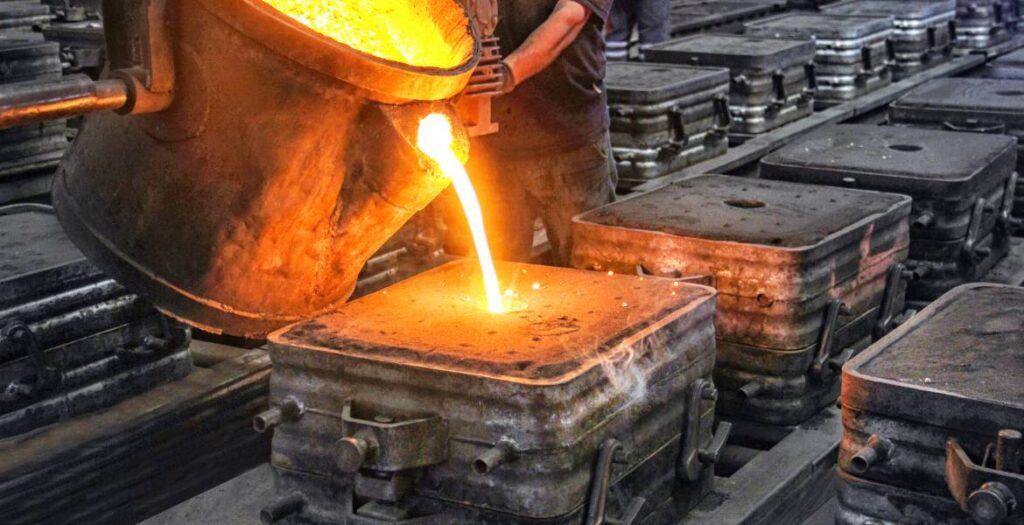
Each alloy requires specific pouring temperatures. For example, aluminum alloys pour at approximately 1,350°F while nickel superalloys may require temperatures exceeding 2,800°F. Molten metal flows into preheated shells, filling the cavity left by the lost wax pattern. Proper pouring technique prevents turbulence and gas entrapment, critical factors in how investment casting works successfully.
Solidification and Shell Removal
The lost wax casting steps continue as the metal transforms from liquid to solid. Cooling rates significantly impact casting microstructure and mechanical properties, with the investment casting method employing controlled cooling cycles particularly for aerospace alloys requiring specific grain structures.
Once castings cool sufficiently, ceramic shells are removed through vibration, hammer knockout, or high-pressure water jets. The brittle ceramic breaks away easily, revealing the metal casting tree inside. Residual ceramic is removed using glass bead or grit blasting, cleaning the casting surface without damaging the metal.
Finishing and Quality Control
The investment casting method concludes with separating individual castings from the tree using band saws, abrasive wheels, or wire EDM depending on material and precision requirements. Cut surfaces are ground smooth to remove any remnants of the gating system, creating clean surfaces that meet engineering specifications.
The lost wax casting steps often include heat treatment to optimize mechanical properties. Many aerospace alloys undergo solution heat treatment to dissolve precipitates and homogenize the microstructure, followed by aging treatments that develop optimal strength through controlled precipitate formation.
While investment casting produces near-net-shape parts, critical features often require CNC machining to achieve final tolerances. Unitritech’s integrated machining capabilities streamline this stage of the investment casting process explained here. Depending on application, castings may receive surface treatments including anodizing, plating, coating, or polishing to enhance corrosion resistance, wear resistance, or aesthetic appearance.
Quality Inspection and Aerospace Certification
The final stage of how investment casting works at aerospace foundries involves comprehensive quality verification. CMM (Coordinate Measuring Machine) inspection verifies that castings meet all dimensional specifications and tolerances with exceptional precision.
Non-Destructive Testing Requirements:
- X-ray radiography to detect internal porosity or inclusions
- Fluorescent penetrant inspection for surface discontinuities
- Ultrasonic testing to verify material soundness
- Magnetic particle inspection for ferromagnetic materials
Material Property Verification:
- Tensile testing to verify strength and ductility
- Hardness testing to confirm heat treatment effectiveness
- Impact testing for critical structural applications
- Metallographic examination of microstructure
AS9100 and NADCAP certifications require complete material traceability and documentation, ensuring every casting in the investment casting process explained here meets aerospace quality standards. Each component includes material test reports, certificates of conformance, and complete documentation from raw material through final inspection.
Advanced Investment Casting Techniques
Modern investment casting methods extend beyond traditional processes to meet evolving aerospace demands.
Vacuum Investment Casting
Understanding how investment casting works under vacuum reveals advantages for reactive metals. Vacuum casting eliminates atmospheric contamination during melting and pouring, enables casting of titanium and other reactive alloys, reduces gas porosity and improves casting soundness, and is essential for aerospace components requiring superior material properties. Unitritech’s vacuum casting capabilities exemplify the advanced investment casting process explained to demanding aerospace customers.
Rapid Prototyping Integration
The lost wax casting steps now incorporate 3D printing technology, revolutionizing prototype development. Direct 3D printing of wax patterns eliminates tooling for prototype quantities, accelerates design iteration cycles from months to days, enables cost-effective low-volume production, and proves particularly valuable in the investment casting method for custom medical implants and aerospace prototypes.
Computer Simulation
Modern understanding of how investment casting works leverages sophisticated software for process optimization. Solidification simulation predicts potential defects before pouring, flow analysis optimizes gating system design, stress analysis predicts dimensional changes and residual stresses, and these tools reduce trial-and-error in the investment casting process explained to engineers.
Applications Across Industries
The investment casting method serves diverse industries with varying requirements and specifications.
Aerospace and aviation applications dominate investment casting production, including turbine blades and vanes for jet engines, structural components requiring complex geometries, landing gear components demanding high strength, and fuel system components requiring corrosion resistance. Medical device applications leverage the precision of how investment casting works for orthopedic implants requiring biocompatibility, surgical instruments with intricate features, dental components demanding precision, and diagnostic equipment housings.
Defense and military applications rely on the lost wax casting steps to produce missile guidance system parts, weapon system components, military vehicle parts, and naval ship components. Industrial equipment applications utilize the investment casting method for pump and valve components, food processing equipment, oil and gas industry parts, and automotive components.
Advantages of Investment Casting
The investment casting process explained thoroughly reveals multiple benefits that make it the preferred manufacturing method for complex precision components.
Design freedom represents a primary advantage of how investment casting works. The process enables complex internal passages impossible to machine, thin walls as thin as 0.030 inches, intricate external features without assembly, and integration of multiple features into single components, reducing part count and assembly costs.
Superior surface finish characterizes the investment casting method, producing excellent as-cast surface finish of 125 Ra or better, reduced or eliminated secondary machining requirements, and smooth internal passages critical for fluid flow applications in aerospace and hydraulic systems.
Dimensional accuracy delivered by the lost wax casting steps includes tight tolerances typically ±0.005 inches, excellent repeatability part-to-part enabling interchangeability, minimal draft requirements allowing near-vertical walls, and near-net-shape production reducing machining costs significantly.
Choosing Investment Casting for Your Components
When evaluating whether the investment casting process explained here suits your needs, consider several key factors. Part complexity makes the investment casting method excel when complex geometries would require extensive machining, internal passages or cores are needed, multiple components could be integrated into one casting, or thin walls and intricate details are specified.
Production volume influences how how investment casting works economically. For prototype to low volumes, 3D printed wax patterns eliminate tooling costs. Medium volumes from 100 to 10,000 parts allow tooling costs to amortize effectively. High-volume production achieves excellent cost per part with automated production systems.
Quality requirements make the investment casting process explained ideal for applications demanding aerospace quality certifications including AS9100 and NADCAP, medical device compliance such as ISO 13485, defense industry standards including ITAR requirements, and complete material traceability from raw material through finished component.
Unitritech's Investment Casting Excellence
Understanding how investment casting works at India’s premier aerospace foundry reveals our commitment to excellence. Our certifications include AS9100 Rev D certified quality management, NADCAP accreditation for NDT and heat treatment, India’s first Airbus-approved investment casting foundry status, and Collins Aerospace approved supplier designation.
Integrated capabilities streamline the investment casting process explained at Unitritech through in-house tooling design and manufacturing, investment casting for aluminum and steel alloys, precision CNC machining with multi-axis capabilities, heat treatment and surface treatments, and complete quality testing and certification.
Frequently Asked Questions
The investment casting process explained simply: create a wax pattern of your part, coat it in ceramic to make a mold, melt out the wax, pour in molten metal, break away the ceramic shell, and you have a precise metal part. This investment casting method produces complex components that would be difficult or impossible to machine from solid stock.
The lost wax casting steps use disposable wax patterns and ceramic molds, unlike permanent mold casting or sand casting. This investment casting method provides superior surface finish, tighter tolerances, and greater design freedom than other casting processes, making it ideal for aerospace and medical applications requiring precision.
Understanding how investment casting works enables engineers to design parts that leverage the process advantages—complex geometries, thin walls, and integrated features. Knowledge of the investment casting process explained here helps optimize designs for manufacturability, cost-effectiveness, and performance while avoiding design features that increase cost without adding value.
The investment casting method for aerospace requires stringent process controls, certified materials, and comprehensive testing. The investment casting process explained for aerospace includes additional quality gates, NADCAP-approved heat treatment, complete material traceability, and documentation meeting AS9100 standards to ensure component reliability and safety.
The complete investment casting process explained timeline varies by complexity. Simple parts with existing tooling may complete in 4-6 weeks, while complex aerospace components requiring new tooling development may take 12-16 weeks. The lost wax casting steps themselves typically require 2-3 weeks once patterns are available for production.
The investment casting method typically achieves ±0.005 inches on most dimensions, with tighter tolerances possible on critical features. Understanding how investment casting works reveals that tolerances depend on casting size, alloy, and geometry—factors your foundry partner can evaluate during design review to optimize both quality and cost.
Conclusion
The investment casting process explained throughout this guide demonstrates why this ancient technique remains indispensable in modern precision manufacturing. Understanding how investment casting works from initial pattern creation through final quality inspection enables informed decisions about component production methods.
The lost wax casting steps refined over millennia and enhanced by modern technology produce aerospace, medical, and defense components meeting the most demanding specifications. Whether you’re developing turbine blades, orthopedic implants, or structural components, the investment casting method offers unmatched design freedom and dimensional accuracy.
At Unitritech, our position as India’s first Airbus-approved investment casting foundry reflects mastery of the investment casting process explained here. Contact our engineering team to discuss how investment casting can optimize your designs and reduce manufacturing costs.
Explore Investment Casting Solutions for Your Components
Partner with India’s leading AS9100-certified investment casting foundry. Our engineering team is ready to review your designs and demonstrate how investment casting enhances performance while reducing costs.