What Is NADCAP Certification and Why It Matters for Aerospace Casting
NADCAP certification aerospace is the gold standard of special-process accreditation — and for precision investment casting foundries supplying aircraft, defence, and space programmes, it is not optional. It is the single credential that separates genuinely qualified aerospace casting suppliers from the rest of the global market, and its absence from a foundry’s quality portfolio is an immediate disqualifier for most OEM procurement teams worldwide.
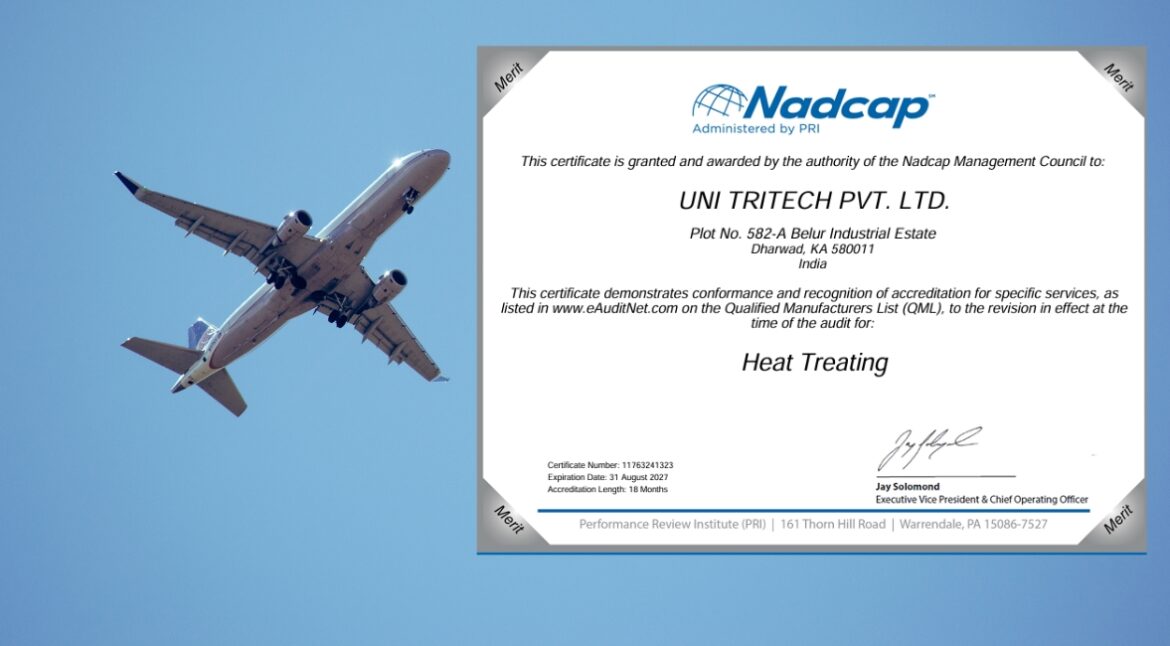
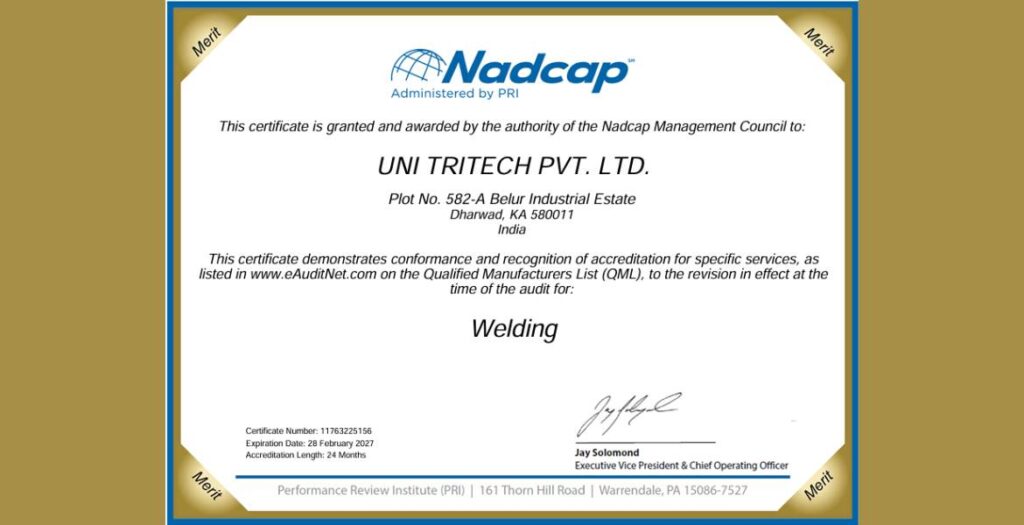
At Uni Tritech — India’s first Airbus and Collins Aerospace-approved investment casting foundry — we hold NADCAP certification aerospace across four scopes: Non-Destructive Testing, Heat Treatment, Welding, and Chemical Processing. In this complete guide, we explain exactly what NADCAP certification involves, how the PRI audit works, and why it must be your very first question when evaluating any precision aerospace casting supplier.

What Is NADCAP Certification Aerospace and Who Controls It?
NADCAP certification aerospace stands for the National Aerospace and Defense Contractors Accreditation Program — a globally recognised, industry-managed accreditation scheme administered by the Performance Review Institute (PRI) on behalf of the world’s leading aerospace prime contractors, including Airbus, Boeing, Safran, Lockheed Martin, GE Aviation, and Rolls-Royce.
Unlike ISO 9001 or even AS9100D, which certify a company’s quality management system, NADCAP accreditation certifies individual special processes — the specific manufacturing operations where equipment variation, process drift, or human error can produce defects that are invisible to standard inspection. Investment casting foundries must seek NADCAP certification for each process scope separately, and each scope requires a dedicated, rigorous technical audit by PRI-trained auditors.
When a foundry achieves NADCAP certification, its approvals are accepted universally by all subscribing prime contractors — eliminating the need for each OEM to conduct its own supplier process audit. This is the central value proposition of NADCAP certification for both aerospace casting suppliers and their customers across the global supply chain.
Why a NADCAP Foundry Is the Only Choice for Aerospace Castings
Choosing a NADCAP foundry for your aerospace casting supply is not simply a procurement preference — it is a contractual requirement on virtually every aerospace prime contractor’s Approved Supplier List. Airbus’s supplier quality requirements, Boeing’s D1-9000, and Safran’s supplier qualification procedures all mandate NADCAP accreditation for special processes on safety-critical components. A NADCAP foundry provides assurance at a level that internal quality systems alone cannot replicate.
The NADCAP audit assesses not just whether the right procedures exist on paper, but whether qualified personnel follow them consistently, whether equipment is calibrated to traceable standards, and whether the process reliably produces the required metallurgical outcome on every production run. This depth of independent, third-party process verification is what makes NADCAP foundry accreditation the definitive quality signal in the global aerospace casting supply chain.
For Indian foundries specifically, NADCAP foundry accreditation opens the door to international aerospace programmes that would otherwise be inaccessible. It signals to procurement teams in Europe, the US, and the Middle East that the foundry’s special processes meet the same rigorous standard as the best foundries anywhere in the world — removing geography as a quality risk factor entirely.
NADCAP Accredited Manufacturer: The Four Scopes That Matter
A truly comprehensive NADCAP accredited manufacturer in the investment casting sector holds accreditation across multiple process scopes — because aerospace castings pass through several special processes before they reach the customer. Uni Tritech’s four NADCAP scopes cover the most critical operations in precision casting:
- Non-Destructive Testing (NDT): Certifies X-ray radiographic inspection and fluorescent penetrant inspection (FPI) procedures, equipment calibration, and inspector qualifications to aerospace prime contractor requirements — the primary internal and surface defect detection methods.
- NADCAP Heat Treatment: Certifies furnace calibration to AMS 2750 pyrometry standards, atmosphere control, load monitoring, and cycle documentation for all thermal processing of aerospace castings — solution annealing, precipitation hardening, and stress relief.
- Welding: Certifies that weld repair processes used on castings are performed by qualified welders under approved procedures — ensuring repaired castings meet the same structural integrity as original cast material.
- Chemical Processing: Certifies surface treatments including passivation of stainless components, chemical cleaning, and conversion coatings — processes where incorrect chemistry or exposure time compromises biocompatibility or corrosion resistance.
As a NADCAP accredited manufacturer across all four scopes, Uni Tritech’s certification portfolio is accepted directly by Airbus, Collins Aerospace, Safran, HAL, and ISRO — eliminating incoming re-inspection costs for customers and accelerating first-article approval timelines.
How NADCAP Heat Treatment Accreditation Works
NADCAP heat treatment accreditation is one of the most technically demanding special-process scopes and one of the most consequential for aerospace investment casting quality. The PRI audit for heat treatment examines every aspect of the thermal processing operation using a detailed checklist developed collaboratively by aerospace prime contractors.
The audit verifies that all production furnaces are calibrated to AMS 2750 pyrometry requirements — including thermocouple placement, instrument calibration traceable to national standards, and System Accuracy Tests (SATs) performed at specified intervals. Every NADCAP heat treatment cycle must be documented with time-temperature charts showing the actual heating, soak, and cooling profile achieved — not just set-point values. NADCAP heat treatment auditors also verify that heat treaters understand the metallurgical rationale for each step, not just following procedures by rote.
This knowledge-based approach to NADCAP heat treatment is what separates genuinely qualified aerospace thermal processing from ordinary heat treatment — and it is the difference between castings whose mechanical properties are predictable and those that vary batch to batch.
Aerospace Quality Certification: NADCAP vs AS9100D vs ISO 9001
Understanding where NADCAP certification aerospace sits relative to other aerospace quality certification frameworks helps procurement engineers make fully informed supplier selection decisions. The three levels operate at different points in the quality assurance pyramid.
ISO 9001:2015 certifies the baseline quality management system — documented procedures, management review, corrective action, and customer focus. It is the entry requirement for any manufacturer and is not specific to aerospace. AS9100D adds aerospace-specific requirements on top of ISO 9001 — risk management, configuration control, key characteristics, first article inspection, and product and process validation requirements. AS9100D aerospace quality certification is required for most aerospace supply chain positions.
NADCAP certification aerospace sits at the apex — it certifies the actual real-time execution of specific high-risk processes to standards set by the global prime contractor community. A foundry can hold full AS9100D aerospace quality certification and still have uncontrolled heat treatment or under-qualified NDT inspectors. NADCAP closes that gap definitively by auditing the process itself, not just the system surrounding it. The combination of ISO 9001 + AS9100D + NADCAP represents the complete quality portfolio of a world-class aerospace casting foundry.
Maintaining NADCAP Certification: The Ongoing Commitment
Achieving NADCAP certification aerospace is the beginning of the commitment, not the end. Accreditation is maintained through periodic re-audits — typically every 12 to 18 months for established suppliers in good standing, and every 6 months for new subscribers or foundries with outstanding audit findings. Between audits, a NADCAP accredited manufacturer must maintain continuous process control — calibrated equipment, trained and certified personnel, controlled consumables, and documented procedures followed consistently on the shop floor every day.
At Uni Tritech, maintaining all four NADCAP scopes simultaneously requires a dedicated quality engineering team, a comprehensive internal audit programme, and a culture of process discipline embedded at every level of the organisation. Our customers benefit directly from this investment — because the same process control that satisfies the PRI auditor is precisely what ensures their aerospace castings arrive defect-free, on time, and with complete traceability documentation every single time.
FAQs About NADCAP Certification Aerospace
NADCAP stands for the National Aerospace and Defense Contractors Accreditation Program. It is administered by the Performance Review Institute (PRI), a non-profit organisation that conducts all NADCAP audits on behalf of aerospace prime contractors including Airbus, Boeing, Safran, and Lockheed Martin. PRI uses technically qualified auditors and prime contractor-approved checklists to assess each special process scope independently.
Uni Tritech holds NADCAP certification aerospace across four scopes: Non-Destructive Testing (NDT), Heat Treatment, Welding, and Chemical Processing. This four-scope NADCAP certification makes Uni Tritech one of the most comprehensively accredited investment casting foundries in India, qualifying the foundry to supply safety-critical aerospace castings to Airbus, Collins Aerospace, Safran, HAL, and ISRO without customer re-inspection.
No. AS9100D is an aerospace quality management system certification — it verifies that a company has documented procedures, management controls, and aerospace-specific process requirements in place. NADCAP certification aerospace certifies the actual live execution of specific special processes such as heat treatment, NDT, and welding to standards set by prime contractors. A foundry can hold AS9100D without NADCAP, but most aerospace primes require both for safety-critical casting supply positions.
NADCAP accreditation is renewed through periodic re-audits — every 12 to 18 months for established NADCAP accredited manufacturers in good standing, and every 6 months for new subscribers or foundries with outstanding non-conformances. Between audits, the foundry must maintain continuous process control, calibrated equipment, and audit-ready documentation. PRI can conduct unannounced surveillance audits at any time as part of the accreditation programme.
Aerospace OEMs require NADCAP certification because special processes such as heat treatment, NDT, and chemical processing are high-consequence operations where failures produce defects that are difficult or impossible to detect after the fact — but that cause catastrophic in-service failures. NADCAP certification provides independent, third-party verification that these processes are controlled to prime contractor standards, eliminating the need for each OEM to conduct its own process audits of every supplier.
Yes, absolutely. A casting can pass all dimensional and visual inspections yet contain sub-surface porosity caused by uncontrolled heat treatment, or surface defects missed by non-NADCAP NDT, or chemical contamination from uncontrolled passivation. NADCAP certification aerospace ensures that the processes producing and inspecting castings are controlled at the deepest level — not just that the finished part looks acceptable on the day of inspection.
Conclusion
NADCAP certification aerospace is not a tick-box exercise — it is an ongoing, audited commitment to process excellence that distinguishes world-class aerospace casting foundries from ordinary metal casters. For procurement managers sourcing flight-critical, defence-critical, or space-critical castings, NADCAP certification must be the first filter applied to any prospective supplier. Uni Tritech’s four-scope NADCAP certification aerospace portfolio, combined with Airbus and Collins Aerospace approval, represents the highest level of verified quality assurance available from any Indian investment casting foundry today.
Want India’s Most Certified NADCAP Foundry for Your Aerospace Programme?
Uni Tritech holds NADCAP certification across four scopes — NDT, Heat Treatment, Welding, and Chemical Processing.
Talk to our team today about your NADCAP-compliant casting requirements.